

Carrier
Get found by the right shippers for what you actually run and the terminals you can actually get into.
The problem
You send the same rate sheet as a PDF to eleven brokers, each one rekeys it into their system, and then asks you again about detention terms you already spelled out. And when a customer needs to know who can run their project — their terminal, the endorsements it takes, the availability — there is nowhere to look, so they call the same carrier they called last time.
What changes
- 1
The right customers find you, not just the ones who already know you
Customers filter by terminal, gate access, credentials, chassis type and hazmat division — not by who they called last time. Your listing may already be in the directory: in the U.S., if the FMCSA census lists you with carrier authority or with none; in Mexico and Canada, if a port, customs or trucking-license register lists you. Companies whose only authority is broker or freight forwarder are not listed as carriers. Claim your listing and it shows what you say you can run.
- 2
Projects come to you, not the other way around
Invitations to quote and direct offers both arrive with the move already structured: terminal, dates, equipment, accessorials. Responding means entering numbers, not writing an email — and declining on time counts as a response too.
- 3
Your rates are just one part of your profile
Publish a lane rate and the previous version closes the moment the new one goes live, so a quote from a month ago still holds at that day's rate. But what makes you eligible is the whole picture: which terminals you get into, with which credentials, what equipment and when — your volume grows on the value of your service, not on being the cheapest.
- 4
Two hundred lanes in one afternoon
Download your whole network as a spreadsheet, update the rates, upload it back. Nothing goes live until you have previewed exactly what changes, and a lane left out of the file is never deleted. Every accessorial uses the same wording for every carrier, and marking one as not offered is a valid answer.
- 5
The brokers that have you set up, confirmed by you
A broker can declare that it has you set up. You're told when it does, and nobody sees it until you confirm it. Confirming only the brokers that really have you set up is what protects you from double brokering.
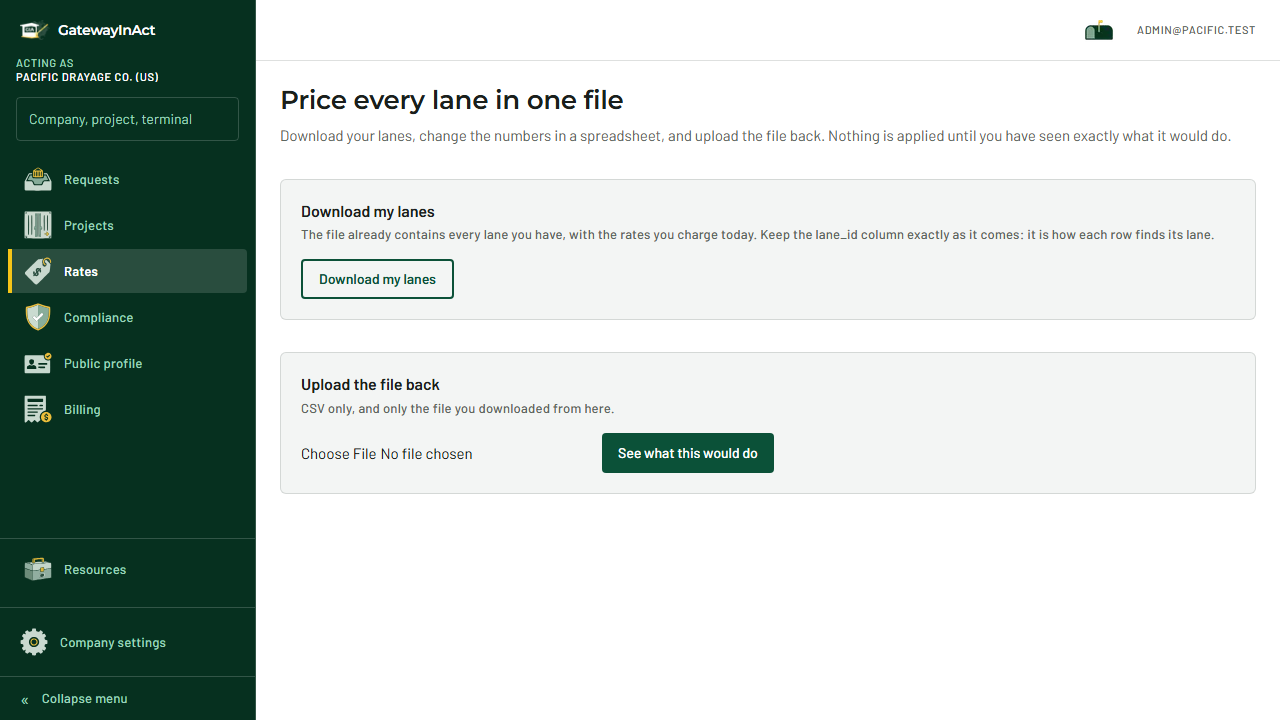
The bulk rate template, before anything is applied.
- USACE as of Aug 21, 2026 · CBSA as of Aug 21, 2026 · SAT as of Aug 21, 2026
- port facilities on record
- 441
- BTS (NTAD) as of Aug 21, 2026 · CBSA as of Aug 21, 2026
- intermodal rail ramps
- 338
- GatewayInAct, agrupación propia as of Sep 15, 2026
- markets
- 220
Each figure is counted from our database, with the date of each of its sources.
Carrier Basic is free. Carrier Pro is USD 33.00 per seat per month
Carrier Basic costs nothing, with no end date: a verified profile, receiving and answering requests, messages and documents. Carrier Pro adds multiple users, analytics, alerts, visibility and integrations, at USD 33.00 per seat per month — the same price whether you pay monthly or annually.
How you pay
Monthly by card, or annually by bank transfer with 8% off for shippers, 3PLs and forwarders. Bank transfer is not an afterthought: a mid-sized company in Mexico would much rather pay an annual invoice by transfer than take a monthly card charge.
The price you sign up at does not go up at renewal.
Be the first in your market. The profile comes first: your terminals, your access, your credentials, your chassis.